
Why AI Auto-Digitizing is Ruining Your Embroidery Business
June 10, 2026
13 min read
Sassy Digitizing
Expert insights, industry trends, and deep dives into the worlds of professional digitizing and embroidery production and vector art.

4.7/5
Guaranteed File Compatibility & Industry Standards






Upload your artwork and get a machine-ready embroidery file in just 2 to 4 hours. No upfront payment. Pay only after you approve. Free revisions included!
2–4 Hours
Rush Turnaround
100% Approval
Pay After Approval
Free Revisions
Until You're Happy
You bought the auto-digitizing software because it promised speed, savings, and simplicity. It delivered something else entirely. Thread breaks three times per garment. Clients returning orders. Designs that look perfect on screen but embarrassing on fabric. Needles snapping on designs that should be straightforward.
The problem is not your machine. It is not your thread. It is not your operator. It is the file. And if that file was produced by an AI auto-digitizing tool, every one of these problems was built into it before your machine ever took its first stitch. This is exactly how AI auto-digitizing is quietly destroying embroidery businesses from the inside out.
⚡ Quick Answer
How is AI auto-digitizing damaging embroidery businesses?
AI auto-digitizing software is marketed on three promises: speed, low cost, and simplicity. The sales pitch is compelling, especially for shop owners who are frustrated by digitizing costs or turnaround times. But when those promises meet the production floor, every single one of them breaks down.
| The Promise | What Actually Happens | Business Cost |
|---|---|---|
| "Saves time" | Thread breaks and bird nesting stop the machine constantly; production time per garment increases | Hours of production time lost per week on operator restarts and re-hooping |
| "Saves money" | Ruined garments, excess thread consumption, and client refunds eliminate the upfront savings immediately | Net cost often higher than professional manual digitizing after production losses are counted |
| "Simplifies the process" | Every order requires manual cleanup of AI output errors; more troubleshooting, not less | Operator skill requirement is higher, not lower; errors compound across orders |
| "Professional quality" | Puckering, distorted shapes, blurry lettering, and visible jump stitches on finished garments | Client complaints, order rejections, damaged brand reputation |
| "Works on any fabric" | Default density and compensation values fail on stretch fabrics, caps, fleece, and most performance wear | Entire garment batches rejected when production fabric differs from the default the AI was built for |
Every thread break costs you time. Your operator has to stop the machine, re-thread, find the break point in the design, back up several stitches, and restart. On a simple left chest logo, this might happen two or three times per garment. On a complex design produced by AI, it can happen ten or more times.
Now multiply that across your production volume. If you run 50 polos per week and each takes three thread break restarts at 3 minutes each, that is 7.5 hours of production time lost every single week. At any reasonable labor rate, that is a significant loss that never appears on your digitizing cost comparison.
Why AI causes this: Auto-digitizing tools create excessive stitch density in small areas because they trace pixel shapes without understanding needle mechanics. High density creates friction and heat that breaks thread. The algorithm has no awareness of how stitch count translates to needle load at production speed.
Bird nesting is the worst production outcome in embroidery. When too many stitches concentrate in one area, the bobbin jams and the thread forms a dense tangle on the back of the fabric. Clearing a bird nest requires cutting away the thread from both sides of the fabric. In most cases, that garment is unsalvageable.
A ruined polo costs you the garment wholesale price, the thread cost, the machine time, and the operator time. If the bird nest occurs halfway through a complex design, you also lose the partial production work already completed. On a corporate uniform order, ruining even two garments per 100 eliminates the entire profit margin on the order.
| Garment Type | Average Wholesale Cost | Loss if Ruined by Bird Nest |
|---|---|---|
| Performance polo | $18 to $35 | Full garment cost plus thread and time |
| Embroidered cap | $8 to $20 | Full cap cost; cap frame re-setup time |
| Fleece jacket | $28 to $65 | Full jacket cost; client replacement required |
| Corporate uniform shirt | $22 to $45 | Garment cost plus potential order cancellation |
Why AI causes this: AI files create density buildups at corners, element boundaries, and detail zones because the algorithm places stitches based on pixel coverage without distributing the load. These density clusters are the direct cause of bobbin jamming and bird nesting on the back of the fabric.
When a corporate client receives 50 polos with puckered logos, misaligned borders, or fuzzy lettering, they do not come back. They also tell other businesses about their experience. In the embroidery industry, where most business comes from repeat clients and referrals, one bad order caused by a poor AI file can eliminate years of relationship building.
The most damaging outcomes from AI-digitized files that reach clients:
💡 The reputation calculation: One lost corporate client who ordered 100 uniforms per year represents thousands of dollars in annual revenue gone permanently. No AI software discount is large enough to justify that risk when a professional manual digitizing file would have prevented the problem entirely.
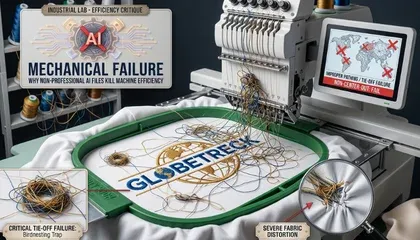
This is the damage most shop owners never connect back to their digitizing files. Embroidery machines are mechanical systems with finite wear tolerance. Every needle strike puts load on the hook assembly, the needle bar, the presser foot mechanism, and the tension system. Over-dense AI files create far more needle strikes per design than an optimized manual file for the same artwork.
Over months of production with AI-generated files running through your machines, the accelerated wear shows up as:
The long-term cost: A commercial embroidery machine represents a significant capital investment. Running it on over-dense AI files shortens its effective service life and increases maintenance costs. These costs never appear in any AI software ROI calculation because software vendors have no visibility into your machine service records.
When shop owners compare AI auto-digitizing to professional manual digitizing, they almost always compare only the upfront file cost. This is the wrong comparison. The true cost of an AI-generated file includes every downstream consequence on the production floor.
| Cost Category | AI File (100-garment run) | Manual File (100-garment run) |
|---|---|---|
| Digitizing file cost | Low (or subscription) | $10 to $30 per design |
| Thread breaks and restart time | 2 to 5 hours operator time lost | Near zero |
| Excess thread consumption | 10 to 25% above optimized stitch count | Optimized; minimal waste |
| Ruined garments | 1 to 3 per 100 (typical) | Rare; QA review prevents most failures |
| Client rejection and rework | Periodic; high cost per incident | Near zero; files are production-vetted |
| Increased machine maintenance | Accelerated wear from density spikes | Standard wear; optimized needle load |
| Total true cost comparison | Higher overall across every run | Lower overall; savings compound with volume |
✅ The honest calculation: On a typical 100-garment production run, an AI auto-digitized file can cost you 2 to 5 hours of operator downtime, 1 to 3 ruined garments, and elevated thread consumption. Compare that to a $15 to $25 professional manual file that runs cleanly from the first stitch. The math is not close.
Not all businesses are equally affected by AI auto-digitizing problems. The damage concentrates in specific operation types where the file quality gap creates the most severe consequences:
Corporate uniform suppliers
These clients expect identical, professional results across every shirt in every order. A single quality inconsistency from a poor AI file is noticed immediately when 50 shirts sit side by side at a distribution event. Corporate clients have the most to lose from brand inconsistency and are the fastest to cancel contracts over quality problems.
Sports team and promotional apparel shops
High-volume batch orders amplify every per-unit problem. Three thread breaks per cap across a 200-cap order is 600 operator restarts. A 2% bird nesting rate on a 500-piece order means 10 ruined garments that must be replaced at your cost before delivery.
Small shops trying to grow
For a small shop, a single large order rejection can eliminate months of profit. Small operations cannot absorb the losses that AI file failures create at scale. The "save money on digitizing" decision that seemed smart when revenue was low becomes catastrophically expensive when a large client order fails in production.
Shops working with premium or stretch fabrics
AI auto-digitizing files apply default compensation values that are designed for stable woven fabrics. Any shop working with performance wear, moisture-wicking polos, stretch knits, or fleece will see the worst of AI auto-digitizing failures because the fabric behavior mismatch is greatest on these substrates.
The alternative to AI auto-digitizing is not learning to digitize yourself. You could spend months learning Wilcom or Hatch, years developing the production knowledge to build files that consistently run clean, and still not match the output of a specialist who has been doing this professionally for a decade.
The practical solution is outsourcing to a professional manual digitizing service. When the cost per file is compared honestly against the production losses from AI files, professional digitizing is not an expense. It is the cheapest operational decision your embroidery business can make.
Zero thread breaks from production-optimized files
Manual digitizing sets density per element and per fabric type. The stitch count is optimized for clean machine operation, not maximum pixel coverage. Files that are built for production do not cause thread breaks under normal conditions.
Fabric-specific compensation prevents puckering and distortion
A professional digitizer sets pull and push compensation values matched to your production fabric. The design on the finished garment matches the approved artwork. No client rejections for design distortion or misalignment.
QA review on every file before it reaches your machine
At Sassy Digitizing, every file passes through a secondary quality assurance check that verifies density, compensation, underlay structure, and thread path sequencing before delivery. Problems are caught before the machine sees the file, not after a garment is ruined.
Free revisions until the file runs clean
If a file needs adjustment after your test sew-out, revisions are included at no additional cost until the production result matches the approved design. You never pay twice for the same file problem.
AI auto-digitizing is not ruining your embroidery business in one dramatic failure. It is doing it gradually: one thread break at a time, one ruined garment per batch, one client who does not come back, one machine that wears out faster than it should. The damage is quiet, ongoing, and compounding.
| ✅ | Thread breaks are a file problem; not a machine problem, not a thread problem, and not an operator problem |
| ✅ | Ruined garments from bird nesting trace directly to AI density buildup; preventable with a properly built manual file |
| ✅ | Client complaints about puckering, distortion, and fuzzy lettering come from AI default settings that ignore fabric behavior |
| ✅ | Machine wear accelerates under over-dense AI files; a cost that compounds invisibly over years of production |
| ✅ | Professional manual digitizing eliminates all of these problems; the per-file cost is the cheapest protection your business can buy |
Every thread break, ruined garment, and client complaint from an AI file costs far more than the professional manual digitizing that would have prevented it. Test the Sassy Digitizing difference free on your first logo.
First logo under 5 inches manually digitized free. Test on your own machines before you commit to a single paid order.
Senior Quality Control (HOD)
As the Head of Quality Control at Sassy Digitizing, Keith brings over 12 years of hands-on commercial embroidery experience to the table. He is our resident problem-solver, specializing in the technical nuances of stitch density, pull compensation, and complex digitizing. When he's not establishing quality standards for 3D puff and appliqué, you'll find him perfecting the art of small lettering to ensure every stitch counts.
Expertise:
Lightning-Fast Delivery
Get your file in 2–4 hours, every time.
Expert Quality
38+ expert digitizers with years of experience.
24/7 Support
We're here to help, anytime you need us.
Secure & Confidential
Your files are safe with us. Always.
Upload your artwork now and let our experts turn it into perfection, fast.
1,794+
Happy Clients
4.7★
Client Rating
38+
Expert Digitizers
6+
Years Experience
© 2026 Sassy Digitizing LLC. All Rights Reserved.

Scale your apparel brand or embroidery shop with the best embroidery digitizing service of 2026. Sassy Digitizing comple…

Stop ruining structured hats with flat sew files. Discover the essential digitizing secrets for curved 3D surfaces inclu…
High embroidery stitch density is the most common reason designs come out stiff, raised and bulky. This guide covers the…