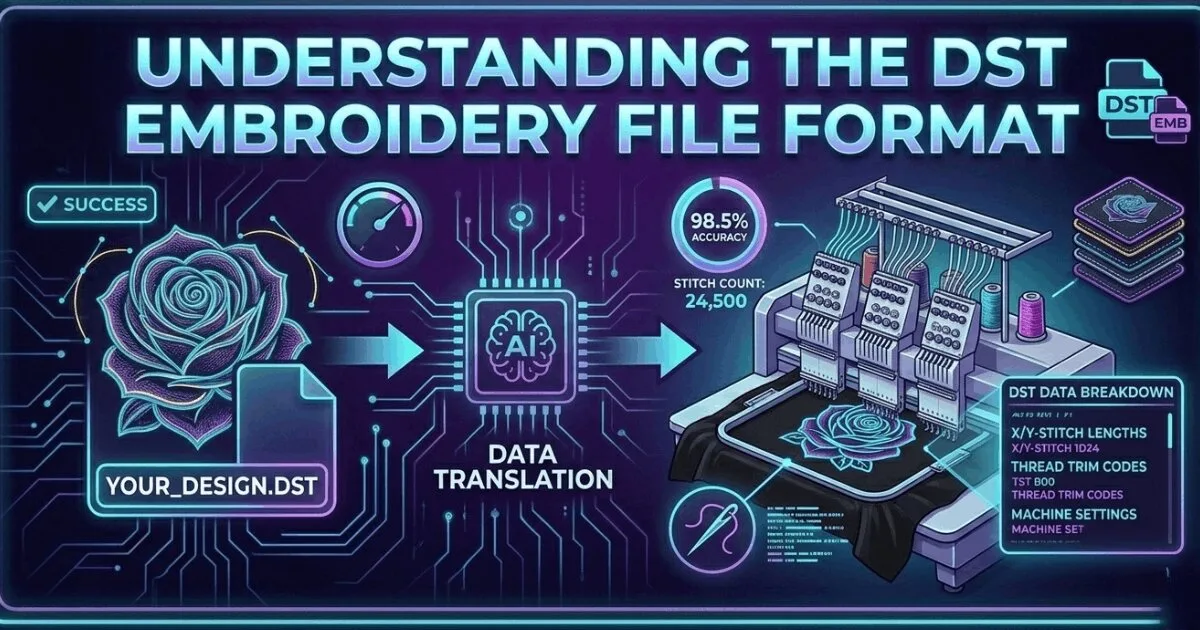
What Is a DST File? The Commercial Embroidery Format Explained
A DST file is the Tajima stitch format used by commercial embroidery machines worldwide. Learn what it contains, which m…
Read More
Vector and raster are the two main image formats in graphic production. Vendors like print shops, embroidery digitizers, screen printers, sign makers, and vinyl cutters will request one of them. Knowing the difference helps avoid rejected files, redraw fees, and delays, and explains why vector is preferred.

4.7/5
Guaranteed File Compatibility & Industry Standards



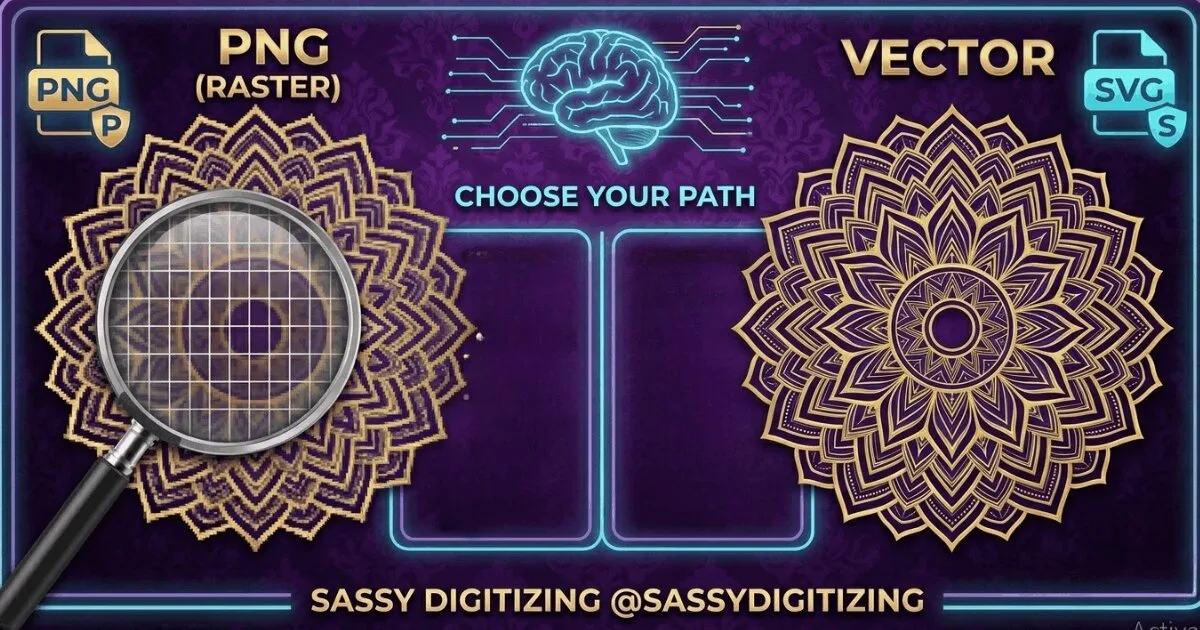
A raster image is made of pixels. A vector file is made of paths. When you scale a raster image up, the pixels become visible and the image blurs. When you scale a vector file up, the paths recalculate and the image stays sharp.
Upload Your ImageJPG, PNG and BMP files are raster format. They store colour as a grid of pixels at a fixed resolution. Scale beyond the original resolution and the pixels become visible. Common raster file types: JPG, PNG, BMP, TIFF, GIF.
AI, EPS and SVG files are vector format. They store colour as mathematical path objects. Scale to any size: billboard or business card, the output is always sharp. Common vector file types: AI, EPS, SVG, PDF vector, CDR.
Raster images are acceptable for: screen display, web use, and high-resolution print where no resizing is needed. At 300 DPI at the final print size, a raster image produces acceptable print quality.
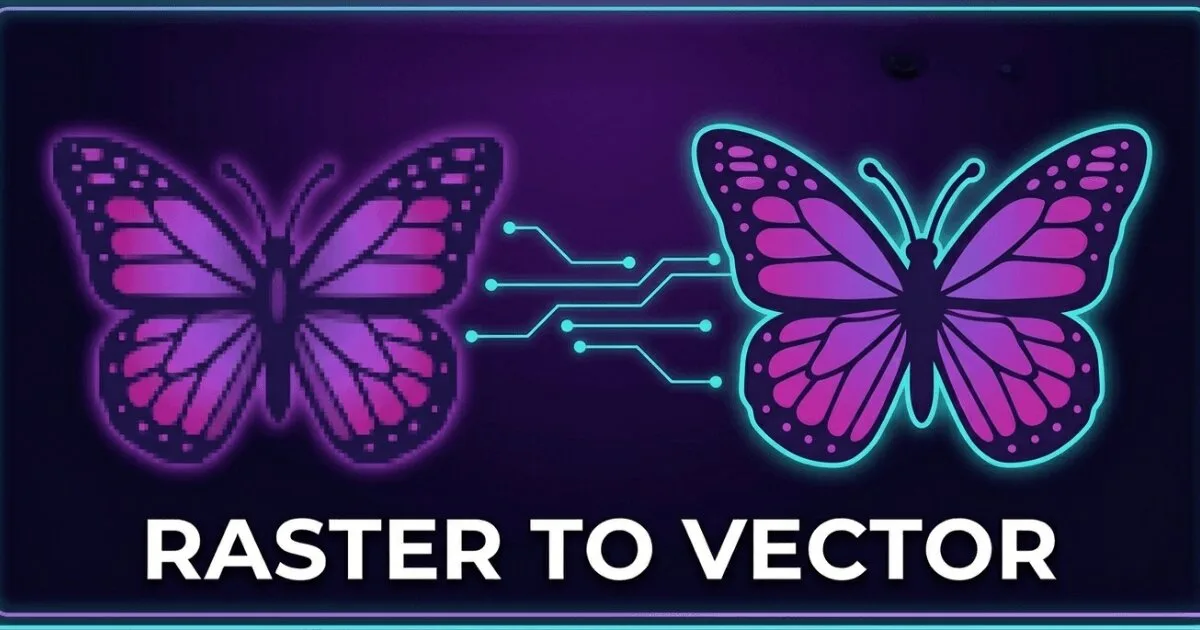
Every raster to vector conversion from Sassy Digitizing is done manually in Adobe Illustrator. No auto-trace. Clean production-ready paths delivered in 2 to 8 hours from $10.
In a design workflow that only ever produces content for screens, the distinction between vector and raster is less critical. The distinction becomes critical the moment a file needs to be used for physical production. A vinyl cutter cannot cut a raster path. A laser engraver cannot follow a pixel edge cleanly. A screen printer needs colour-separated vector layers to burn individual screens. An embroidery digitizer produces a better file from a clean vector reference than from a raster source of the same logo.
The most common format mistake in embroidery and print shops is accepting a logo from a client as a JPG or low-resolution PNG and proceeding directly to production without converting it to vector first. The client often does not know their logo needs to be in a specific format. They simply send what they have. The shop's job is to either request the vector source file from the client or convert the raster file to vector before starting production.
Pixel based, fixed resolution
Path based, infinitely scalable
Here is the practical rule for any production workflow: if the job involves cutting, engraving, screen printing, or large format printing, start with a vector file. If the job involves only digital display, web use, or low-volume small-format digital print, raster at sufficient resolution works. When in doubt, vector is always the safer choice because a vector file can always generate a raster export, but a raster file cannot be automatically converted to a high-quality vector.
💡 When a client sends a JPG logo, do not begin production. Either ask the client for the original source vector file or send the JPG to Sassy Digitizing for professional vector conversion. The conversion cost is always less than the cost of wasted production time and materials from using a poor-quality source file.
✓ Do this:
✗ Avoid this:
The fastest way to identify a file type is to open it in any viewer and zoom in to 800 percent or more. If the edges remain perfectly sharp and clean at full zoom, it is a vector file. If you see pixels, blurring, or jagged edges when zoomed in, it is a raster file regardless of what the file extension says. A PDF with a vector logo and a PDF with a scanned document look the same on the outside but are completely different inside.
💡 A file named logo.pdf does not mean it is a vector file. PDFs can contain raster data, vector data, or both. Always test by zooming in before treating any PDF as a vector source file.
✓ Do this:
✗ Avoid this:
| Format | Type | Scalable | Production Ready | Best For |
|---|---|---|---|---|
| JPG | Raster | No | No | Web display and photos |
| PNG | Raster | No | No | Web with transparency |
| TIFF | Raster | No | Partial | High-resolution digital archive |
| AI | Vector | Yes | Yes | Professional logo master file |
| EPS | Vector | Yes | Yes | Legacy production standard |
| SVG | Vector | Yes | Yes | Web and cutting machines |
| PDF (vector source) | Vector | Yes | Yes | Client production file |
| PDF (scanned source) | Raster inside PDF | No | No | Requires conversion to vector |
Need your raster logo converted to a clean production-ready vector file? Delivered in 2 to 4 hours.
Get Clean Print FilesSenior Graphic Illustrator and Vector Artist
With a decade of experience in digital illustration, Rory is the go-to expert at Sassy Digitizing for complex artwork transitions. He specializes in the intricate process of converting raster images into clean and production-ready vectors. Rory’s deep understanding of file architecture, specifically the nuances between PNGs and scalable curves, ensures that every design maintains perfect clarity regardless of size or application.
Expertise:
Go behind the scenes of our design process. Discover technical tips for embroidery digitizing and best practices for high-quality vector conversions.
We manually recreate low-quality raster images into professional vector files ready for printing and branding.
Everything you need to know about our embroidery digitizing service, pricing, file formats, turnaround times and revision policy.
Resolution is critical for raster images like JPG, PNG, and TIFF files. A minimum of 300 DPI is recommended for clean print output at the intended size. Lower resolution images become pixelated and blurry when enlarged. Vector files are completely resolution-independent and stay perfectly sharp at any scale because they are built from mathematical paths rather than pixels, allowing infinite scaling without quality loss.
Raster to vector conversion is done by manually tracing the image in Adobe Illustrator. Each shape and element is rebuilt as clean vector paths by skilled artists. Auto-trace tools produce jagged edges and unusable results for production. Manual conversion produces AI, EPS, and SVG files suitable for embroidery, screen printing, vinyl cutting, and large format printing. Pricing starts at $10 with 2–8 hour delivery.
Yes, manual tracing produces significantly better results than auto-trace software. It creates smooth curves, clean anchor points, and production-ready paths. Auto-trace tools generate rough edges, excess anchor points, and files that often fail in professional production workflows. Manual tracing ensures accuracy, stability, and clean output suitable for commercial use.
Common vector formats include AI (Adobe Illustrator native format), EPS (universal vector format), SVG (web and modern applications), PDF with vector data, and CDR (CorelDRAW format). We provide AI, EPS, and SVG formats in every order to ensure compatibility across all design and production systems.
The main advantage of vector graphics is infinite scalability without quality loss. Vectors remain sharp at any size because they are based on mathematical paths instead of pixels. This makes them essential for logos, embroidery, screen printing, vinyl cutting, and large format printing, unlike raster images which lose quality when scaled.
Upload your artwork and get a machine-ready embroidery file in just 2 to 4 hours. No upfront payment. Pay only after you approve. Free revisions included!
2–4 Hours
Rush Turnaround
100% Approval
Pay After Approval
Free Revisions
Until You're Happy
Lightning-Fast Delivery
Get your file in 2–4 hours, every time.
Expert Quality
38+ expert digitizers with years of experience.
24/7 Support
We're here to help, anytime you need us.
Secure & Confidential
Your files are safe with us. Always.
Upload your artwork now and let our experts turn it into perfection, fast.
1,794+
Happy Clients
4.7★
Client Rating
38+
Expert Digitizers
6+
Years Experience
Clients return because files run clean on machines and delivery timelines are consistently met. 4.7-star average on Google and Trustpilot. 54273+ designs delivered.


Wonderful Digitizer! FAST and Efficient. Wonderful Communication

Quick response. Excellent quality files. Reasonable rates.

I've been working with Sassy for almost a year now. There service and quality of work is top notch!!

Great quality, great price and great to work with! Have used them twice and will continue to use them in the future.

Great personal service. Quick, reliable quality work. A very customer oriented operation. Thank you!

Always top notch service from these guys! They do such a wonderful job. Have been using them a long time

It is very simple to make edit requests. Thank you

We just starting working with Sassy Digitizing. They are very responsive and have provided great stitch files. Even if a file needs to be edited they are quick to respond. So far so good!

Great communication. Easy and transparent process. Super quick too! We used Sassy Digitizing to help get some image files converted for an event t-shirt. End result was perfect. Definitely recommend to others.

I highly recommend Sassy Digitizing. Easy to submit, quick turnaround and stitches out beautifully! I use them for all of my digitizing needs.

The sassy team was super responsive, communicated well, and turned each project around super quickly. Highly recommend.

I've been working with Sassy for almost a year now. There service and quality of work is top notch!!

Great files and quick turnaround time.

Quick and easy, very painless. I will be using this service from now on.

Sassy does all of my digitizing and each logo stitches out beautifully

Clothing authority always has the product I need has great shipping prices and timely delivery
Francis Brady
Top notch service at a low price! Can't beat that! Been using these guys for a while now. They get the job done every single time. Never a disappointment! Thank you guys as always!
Joe Hamilton
They are always good quality and if there is something I do not like - they fix it
Becky Wof
Fast turnaround! Stitches beautifully.
Vickie Nimer
This was my first time doing business with AOGU apparel so I ordered a sample. I was very pleased with the sample and made a bulk order. I was very impressed with the quality, style, and design of the merchandise and so was my customers. I do plan to make more orders in the future.
Alquin Parker
I've been very satisfied with everything I've ever had done. Convenient, easy to use website makes it even better.

MsNform
They strive hard to please, their customers. Very reasonable priced also. That is who I use when I need something done, thank you much, Paula
Paula Rudolph
GREAT COMPANY TO WORK WITH. EFFICIENT, QUICK AND VERY PROFESSIONAL.
nicholas tolentine
From the beginning of my project til the end, John was extremely responsive and customized all my images perfectly. I will use Sassydigitizing for all my custom work in the future. They are professional and timely.
Cheryl Jokich
MSP Embroidery and More have used Sassy Digitizing for over two years. They provide top notch service as reasonably priced. They are always willing to go over and above the call of duty to assist us. They are also very accommodating. I highly recommend them and will continue using them. Thank you Sassy

Marshalle Peay
They always do a great job and are super easy to work with. Always willing to make quick fixes if needed as well. Highly recommend!

Keli Casey
I love Sassy Digitizing! They give professional, prompt service. They cater to their customers to provide them with the best service possible!

Dawn Bradley
Very fast response time and I'm happy with the result. Just make sure you know exactly what you want and be very clear with images, color codes etc 🙌🏼 Will use again for sure!

Chris Law
I have never worked with such a kind, knowledgeable company. Ben is absolutely amazing and extremely fast at completing any design you throw his way with great file quality. Very fast responses and they go above and beyond. I would recommend sassy digitizing to everyone who needs any design
Ash
Sassy Digitizing is the best in the industry! Great Quality and fast turnaround! They have amazing attention to detail and are always following up to make sure the files sew as we expected! I've worked in the industry for 25yrs and my only regret is not partnering with Sassy sooner!!!

Absolute Screen Printing