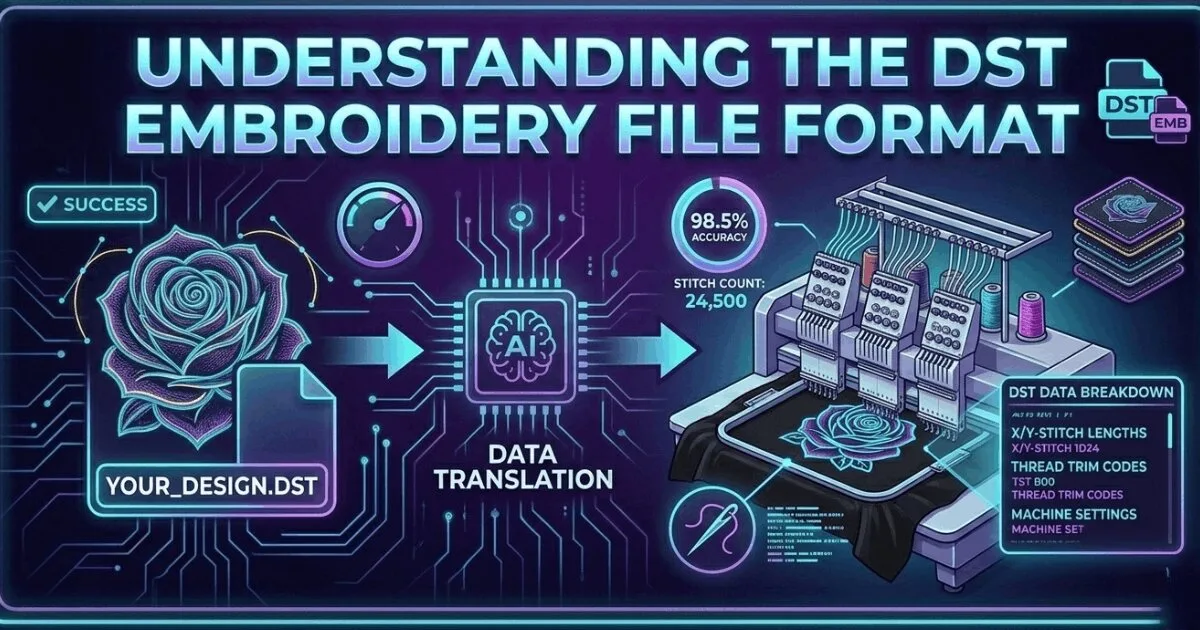
What Is a DST File? The Commercial Embroidery Format Explained
A DST file is the Tajima stitch format used by commercial embroidery machines worldwide. Learn what it contains, which m…
Read More
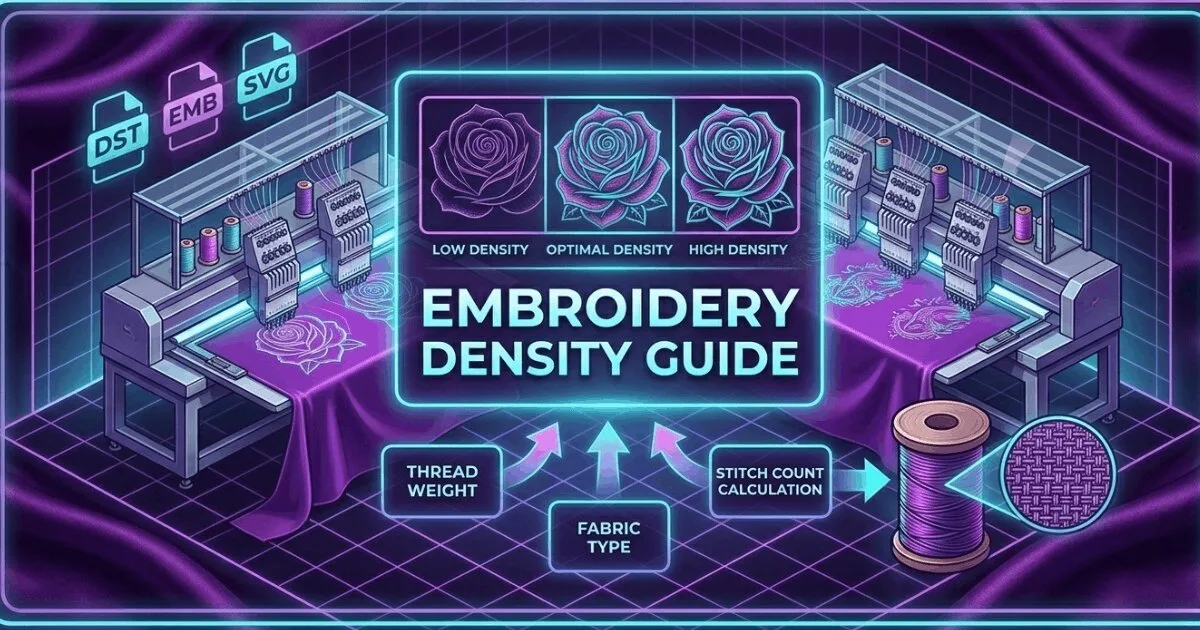
Embroidery density determines how tightly stitches are packed in fill or satin areas and is the most critical digitizing setting. Too high causes puckering and thread or needle breaks; too low exposes fabric. Density varies by fabric and must be set per design element.

4.7/5
Guaranteed File Compatibility & Industry Standards





What stitch density is, why it is important in embroidery, how the wrong density settings affect your embroidery and what makes density settings different in different fabrics.
Too many stitches per square inch causes fabric puckering, needle breakage, thread breaks and fabric damage. Common in auto-digitized files that use maximum density settings regardless of fabric type.
Too few stitches per square inch leaves gaps in coverage, showing the base fabric through the embroidery. Also causes loose, unstable stitches that snag and unravel.
Woven fabrics, pique polo, fleece, knit and stretch all require different density settings. A setting correct for woven twill will cause puckering on pique polo. We configure density per fabric type on every order.
Auto-digitizing software uses the same density setting for every element. Manual digitizing in Wilcom V9 and E2 allows our digitizers to set density individually for each stitch region based on stitch type and fabric.
Density determines how tightly stitches are packed together across the design. A well-calibrated density gives the finished embroidery a smooth, flat surface with complete colour coverage and no visible fabric underneath the stitches. A poorly calibrated density creates one of two problems: fabric showing through where stitches are too sparse, or puckering and thread bunching where stitches are packed too tightly for the fabric to absorb them.
A rigid woven twill fabric and a stretch performance knit need completely different density settings for the same design. The twill supports high stitch density because its tight weave holds stitches without distorting. The performance knit needs lower density because the fabric has stretch and cannot absorb as many stitches without pulling and bunching. Auto-digitizing software applies a single standard density setting to all fabrics, which is why auto-generated files often produce inconsistent results across different garment types.
Thin, gappy, unprofessional result
Puckering, thread breaks, stiff result
The easiest way to check density is to run a test sew on a matching fabric sample before starting the full production run. A correctly digitized file will produce a smooth, flat embroidery with complete colour coverage, no visible puckering, and no thread breaks through the normal run. If any of these problems appear consistently at the same point in the design, the density needs adjustment in that area.
💡 When ordering from Sassy Digitizing, tell us the fabric type and garment brand. We calibrate density specifically for each fabric rather than applying a standard setting. This is the main reason our files run correctly on the first hoop.
✓ Do this:
✗ Avoid this:
Different fabrics require different density settings to achieve the same clean result. Woven twill handles standard density well because its tight weave supports the stitches. Stretch knit and fleece need reduced density and extra underlay. Terry towel fabric needs the lowest density of all common fabrics combined with the most aggressive underlay to prevent stitches from sinking into the pile.
💡 Sassy Digitizing adjusts density per fabric on every order. Just tell us what garment brand and fabric type you are sewing on and we handle the rest.
✓ Do this:
✗ Avoid this:
| Fabric Type | Recommended Density | Underlay Type | Notes |
|---|---|---|---|
| Woven Twill | Standard 0.40 to 0.45mm | Edge run plus zigzag | Most forgiving fabric for embroidery |
| Pique Knit (Polo) | Reduced 0.45 to 0.50mm | Full zigzag | Use topping on textured pique |
| Performance Stretch | Low 0.50 to 0.60mm | Full zigzag plus extra edge run | Needs firm cut-away stabiliser |
| Fleece | Low 0.50mm or less | Zigzag at reduced density | Use topping to prevent stitches sinking |
| Denim and Canvas | Standard 0.35 to 0.45mm | Full underlay | Strong fabric handles standard density |
| Terry Towel | Lowest 0.55 to 0.70mm | Heavy zigzag underlay | Aggressive underlay essential for pile fabric |
Need a file with correct density for your fabric? Tell us your garment type and we calibrate specifically for your production.
Get Expert File ReviewSenior Quality Control (HOD)
As the Head of Quality Control at Sassy Digitizing, Keith brings over 12 years of hands-on commercial embroidery experience to the table. He is our resident problem-solver, specializing in the technical nuances of stitch density, pull compensation, and complex digitizing. When he’s not establishing quality standards for 3D puff and appliqué, you’ll find him perfecting the art of small lettering to ensure every stitch counts.
Expertise:
Go behind the scenes of our design process. Discover technical tips for embroidery digitizing and best practices for high-quality vector conversions.
Get manually digitized embroidery files optimized for clean production and balanced stitch density.
Everything you need to know about our embroidery digitizing service, pricing, file formats, turnaround times and revision policy.
Yes, excessive stitch count for a given design size usually indicates over-density, where too many stitches are packed into a small area. This creates multiple production problems including frequent thread breaks, needle damage and breakage, fabric distortion and puckering, and poor embroidery appearance. A properly manually digitized file balances stitch count with fabric type, design size, and intended use. Professional digitizers adjust density based on these factors rather than using one-size-fits-all auto-digitizing settings.
Yes, fabric type directly and significantly affects required density settings. Woven fabrics like twill and pique use standard density of 4.5-5.0 lines per millimeter. Fleece requires lower density (4.0-4.5) with stronger underlay to prevent sinking. Knit and stretch fabrics need lighter density (4.0-4.5) with edge-run underlay to accommodate fabric movement. Towelling requires the lowest density (3.5-4.0) to avoid stitches disappearing into the pile. Using incorrect density for your fabric type leads to poor quality and production failures.
Correct embroidery density produces specific quality indicators you can inspect visually and by touch. The embroidered area feels firm but not overly stiff or rigid. Fill areas appear smooth with complete coverage and no visible fabric gaps. Satin columns have consistent sheen without gaps or overlapping. Thread breaks are minimal during production (less than 1-2 per 10,000 stitches). If you observe puckering or fabric distortion, density is too high. If fabric shows through fills, density is too low.
Yes, underlay stitching has its own separate density setting independent from top stitch density. Underlay density should be approximately 30-40% lighter than top stitching. If underlay density is too high, it causes fabric puckering and increases thread break frequency. If underlay density is too low, the design lacks stability and registration. Proper underlay setup and density control is essential for professional embroidery quality and is frequently misconfigured or completely missing in auto-digitized files.
Excessive embroidery density creates severe production problems. High density causes thread breaks because the needle repeatedly penetrates already saturated fabric, increasing friction and thread stress. It creates puckering due to excessive thread tension pulling fabric in multiple directions simultaneously. The embroidered area becomes overly stiff and uncomfortable. Production time increases significantly. Needle breakage becomes more frequent. In extreme cases, the embroidery machine may stall or show error codes. Professional digitizers balance density for coverage without over-saturation.
Upload your artwork and get a machine-ready embroidery file in just 2 to 4 hours. No upfront payment. Pay only after you approve. Free revisions included!
2–4 Hours
Rush Turnaround
100% Approval
Pay After Approval
Free Revisions
Until You're Happy
Lightning-Fast Delivery
Get your file in 2–4 hours, every time.
Expert Quality
38+ expert digitizers with years of experience.
24/7 Support
We're here to help, anytime you need us.
Secure & Confidential
Your files are safe with us. Always.
Upload your artwork now and let our experts turn it into perfection, fast.
1,794+
Happy Clients
4.7★
Client Rating
38+
Expert Digitizers
6+
Years Experience
Clients return because files run clean on machines and delivery timelines are consistently met. 4.7-star average on Google and Trustpilot. 54273+ designs delivered.


Wonderful Digitizer! FAST and Efficient. Wonderful Communication

Quick response. Excellent quality files. Reasonable rates.

I've been working with Sassy for almost a year now. There service and quality of work is top notch!!

Great quality, great price and great to work with! Have used them twice and will continue to use them in the future.

Great personal service. Quick, reliable quality work. A very customer oriented operation. Thank you!

Always top notch service from these guys! They do such a wonderful job. Have been using them a long time

It is very simple to make edit requests. Thank you

We just starting working with Sassy Digitizing. They are very responsive and have provided great stitch files. Even if a file needs to be edited they are quick to respond. So far so good!

Great communication. Easy and transparent process. Super quick too! We used Sassy Digitizing to help get some image files converted for an event t-shirt. End result was perfect. Definitely recommend to others.

I highly recommend Sassy Digitizing. Easy to submit, quick turnaround and stitches out beautifully! I use them for all of my digitizing needs.

The sassy team was super responsive, communicated well, and turned each project around super quickly. Highly recommend.

I've been working with Sassy for almost a year now. There service and quality of work is top notch!!

Great files and quick turnaround time.

Quick and easy, very painless. I will be using this service from now on.

Sassy does all of my digitizing and each logo stitches out beautifully

Clothing authority always has the product I need has great shipping prices and timely delivery
Francis Brady
Top notch service at a low price! Can't beat that! Been using these guys for a while now. They get the job done every single time. Never a disappointment! Thank you guys as always!
Joe Hamilton
They are always good quality and if there is something I do not like - they fix it
Becky Wof
Fast turnaround! Stitches beautifully.
Vickie Nimer
This was my first time doing business with AOGU apparel so I ordered a sample. I was very pleased with the sample and made a bulk order. I was very impressed with the quality, style, and design of the merchandise and so was my customers. I do plan to make more orders in the future.
Alquin Parker
I've been very satisfied with everything I've ever had done. Convenient, easy to use website makes it even better.

MsNform
They strive hard to please, their customers. Very reasonable priced also. That is who I use when I need something done, thank you much, Paula
Paula Rudolph
GREAT COMPANY TO WORK WITH. EFFICIENT, QUICK AND VERY PROFESSIONAL.
nicholas tolentine
From the beginning of my project til the end, John was extremely responsive and customized all my images perfectly. I will use Sassydigitizing for all my custom work in the future. They are professional and timely.
Cheryl Jokich
MSP Embroidery and More have used Sassy Digitizing for over two years. They provide top notch service as reasonably priced. They are always willing to go over and above the call of duty to assist us. They are also very accommodating. I highly recommend them and will continue using them. Thank you Sassy

Marshalle Peay
They always do a great job and are super easy to work with. Always willing to make quick fixes if needed as well. Highly recommend!

Keli Casey
I love Sassy Digitizing! They give professional, prompt service. They cater to their customers to provide them with the best service possible!

Dawn Bradley
Very fast response time and I'm happy with the result. Just make sure you know exactly what you want and be very clear with images, color codes etc 🙌🏼 Will use again for sure!

Chris Law
I have never worked with such a kind, knowledgeable company. Ben is absolutely amazing and extremely fast at completing any design you throw his way with great file quality. Very fast responses and they go above and beyond. I would recommend sassy digitizing to everyone who needs any design
Ash
Sassy Digitizing is the best in the industry! Great Quality and fast turnaround! They have amazing attention to detail and are always following up to make sure the files sew as we expected! I've worked in the industry for 25yrs and my only regret is not partnering with Sassy sooner!!!

Absolute Screen Printing