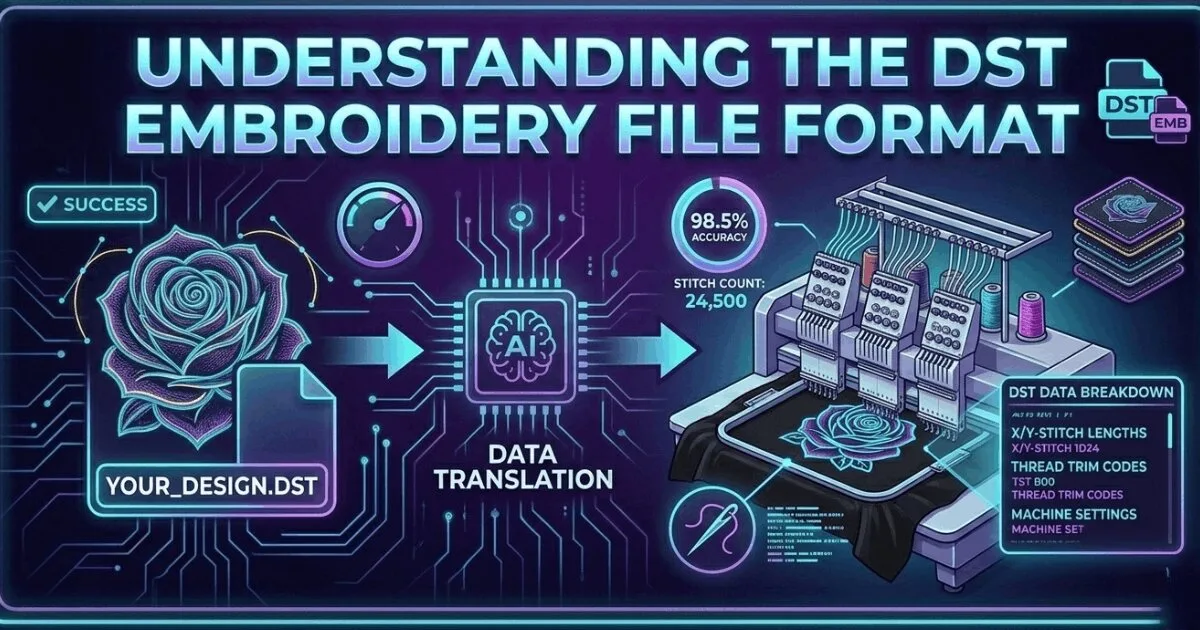
What Is a DST File? The Commercial Embroidery Format Explained
A DST file is the Tajima stitch format used by commercial embroidery machines worldwide. Learn what it contains, which m…
Read More
Seven questions that separate professional manual digitizing services from auto-digitizing operations charging the same price. Know what to ask before you place your first order.

4.7/5
Guaranteed File Compatibility & Industry Standards




The single most important factor when choosing an embroidery digitizing service is whether the digitizer builds stitch paths by hand or uses automated software to generate them from an uploaded image. Manual digitizing means a skilled human opens your artwork in professional software, typically Wilcom V9, E2, or Hatch, and builds every stitch path, underlay type, density setting, and pull compensation value individually for each design element. The digitizer makes decisions based on your fabric type, garment construction, and production environment. Auto-digitizing (also called AI digitizing) means software analyses your image and automatically generates stitch paths using algorithms. No human reviews the output. The software does not know your fabric type, machine type, or production constraints. Auto-digitized files produce first-run production success rates of 40–60% on complex or stretch-fabric designs. Manual digitizing consistently achieves 99%+ first-run success. The $5–$10 price premium for manual digitizing is recovered on the first production run it prevents you from wasting.
Embroidery digitizing pricing ranges from $5 for auto-digitized files to $20 or more for manually digitized complex designs. Understanding what determines price helps you make the right value decision. Auto-digitizing services charge $5–$10 per file because the process is automated. Processing takes seconds. There is no skilled labour cost. The price reflects that fact accurately. Manual digitizing services charge $15–$25 for standard designs because a skilled digitizer spends 30–90 minutes on each file. Standard flat-rate pricing, such as $15 for cap logos and left chest designs regardless of stitch count, is the clearest pricing model. It means your costs are predictable and there are no surprise surcharges for complexity. Per-stitch pricing models charge differently based on stitch count. This can be reasonable, but watch for artificially inflated stitch counts. A well-digitized 8,000-stitch left chest logo should cost roughly the same as a 10,000-stitch version of the same design. Always factor in revision costs. Services that charge per revision can quickly exceed the price of a quality manual digitizing service that includes free unlimited revisions.
Standard turnaround for professionally manual-digitized files is 2–4 hours for designs under 15,000 stitches. Rush turnaround of 1–2 hours is offered by some services for straightforward designs. Auto-digitizing services deliver in minutes because processing is automated. If a service advertises instant delivery for complex designs, it is auto-digitized regardless of what they claim. Be sceptical of "24-hour turnaround" claims from manual digitizing services. Legitimate manual digitizing takes 30–90 minutes per design. If a service has a 24-hour standard window, they are either processing a large queue of low-priority orders or the work is manual but without a quality review step. For commercial embroidery shops, 2–4 hour turnaround is the practical gold standard. It lets you receive a file, run a test sew, and begin production within the same working day.
Revision policy is one of the clearest indicators of a digitizing service's confidence in their work. Services that include free unlimited revisions are confident their files will run correctly. Services that charge per revision know their files frequently need corrections. Common paid revision models charge $5–$15 per revision request. On an auto-digitized file that required three rounds of corrections, you have already doubled the original file cost; you still may not have a file that runs reliably on all fabric types. Evaluate revision policy before ordering. A service that includes unlimited free revisions until the file runs correctly on your machine is offering a quality guarantee by another name. It aligns the service's incentive with your production outcome. Also ask whether revisions are handled by the original digitizer or routed to a general queue. Revisions are most effective when the original digitizer reviews and corrects their own work.
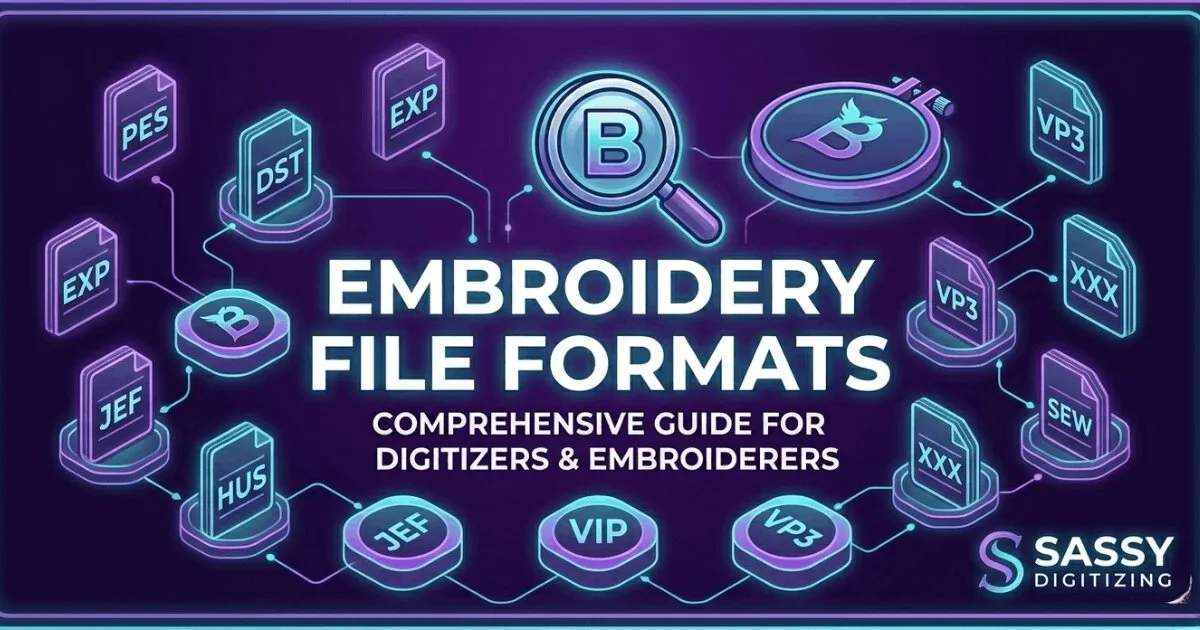
A professional digitizing service should deliver your files in all major formats without additional charges. DST, PES, EMB, JEF, VP3, HUS, XXX, and EXP cover the vast majority of commercial and home embroidery machines. DST is the universal commercial format accepted by Tajima, Barudan, SWF, ZSK, Happy, and most industrial multi-head systems. PES is the native Brother and Baby Lock format. JEF is for Janome machines. VP3 is for Viking and Husqvarna machines. If a service charges extra for additional format conversions, the cost model is designed for you to pay more. Standard practice in the industry is to include all formats in the base price. Also confirm that format conversion is done from the original digitized file, not by running a DST file through a conversion tool. Machine-converted files often lose stitch data and produce poorer results.
The EMB file is the editable Wilcom source file that contains every stitch parameter, colour sequence, and object-level setting for your design. It is the master file. Every other format (DST, PES, JEF) is exported from it. If you own the EMB source file, you can make future edits through any Wilcom-based digitizer without paying for a full re-digitize. Size changes, colour resequencing, format additions, and fabric adjustments all take minutes from a source file versus hours for a full re-digitize. Most auto-digitizing services do not provide source files because their files are generated, not crafted. Some manual services withhold source files to maintain recurring revenue from edit requests. A service that includes the EMB source file in the base price is giving you full ownership of your digitizing investment. This is the right policy.
100% human-built stitch paths
Algorithm-generated stitch paths
Ask the service directly: is this file digitized manually or processed by software? A legitimate manual service will name their software (Wilcom, Hatch, Pulse) and their digitizer's experience. Vague answers like 'our experts use AI-assisted tools' mean auto-digitizing.
💡 Request a sample file before ordering. Run it on scrap fabric. A manually digitized sample will run clean on the first sew-out.
✓ Do this:
✗ Avoid this:
A confident manual digitizing service will answer this question directly. Auto-digitizing services cannot, because their output is variable by design. If a service cannot give you a straight answer on production reliability, you have your answer.
💡 Ask for production references from commercial embroidery shops, businesses running 50+ pieces per design. Their experience reflects real production conditions.
✓ Do this:
✗ Avoid this:
Ask specifically: if the file causes thread breaks on my machine and fabric, do I get a free revision? The answer should be yes, unconditionally. Anything less means the service does not stand behind their production quality.
💡 Free revisions are only valuable if they are handled by a skilled digitizer, not by running the file through a conversion tool again.
✓ Do this:
✗ Avoid this:
Confirm that DST, PES, JEF, VP3, and EMB are all included in the base price. If format additions cost extra, the service is structured to extract additional revenue from format conversions that take seconds to produce.
💡 Ask whether formats are converted from the original digitized file or from a machine-converted secondary file. Source-converted formats are always higher quality.
✓ Do this:
✗ Avoid this:
Need a production-ready DST file? Delivered in 2 to 4 hours.
Order NowSenior Quality Control (HOD)
As the Head of Quality Control at Sassy Digitizing, Keith brings over 12 years of hands-on commercial embroidery experience to the table. He is our resident problem-solver, specializing in the technical nuances of stitch density, pull compensation, and complex digitizing. When he’s not establishing quality standards for 3D puff and appliqué, you’ll find him perfecting the art of small lettering to ensure every stitch counts.
Expertise:
Go behind the scenes of our design process. Discover technical tips for embroidery digitizing and best practices for high-quality vector conversions.
Test a manually digitized file on your machine before committing to a service. We'll digitize your artwork by hand and deliver a production-ready file in 2-4 hours; no upfront payment required.
Everything you need to know about our embroidery digitizing service, pricing, file formats, turnaround times and revision policy.
Ask the service directly which software their digitizers use. Legitimate manual digitizing services will name specific professional software such as Wilcom V9, Wilcom E2, Hatch Embroidery, or Pulse. They will also be able to tell you the average experience level of their digitizers. Services that use auto-digitizing often describe their process with vague language like 'AI-assisted digitizing' or 'advanced algorithms.' Another test: request a sample file and run it on scrap fabric matching your production fabric. A manual file will run cleanly on the first sew-out. Auto-digitized files frequently require multiple correction rounds.
Fair pricing for manual embroidery digitizing starts at $15 for standard left chest and cap logo designs. Jacket backs and large-format designs typically cost $20–$30. Auto-digitizing services charge $5–$10, but this pricing reflects the automated nature of the work; no human reviews the output. The $5–$10 premium for manual digitizing is recovered on the first production run it prevents you from wasting on thread breaks, puckering, or registration failures. Be suspicious of services charging manual-digitizing prices ($15+) but delivering in under 30 minutes; that turnaround is only possible with automated processing.
No. A professional manual digitizing service should include free unlimited revisions until the file runs correctly on your machine and fabric. Revision charges are a sign that the service does not stand behind their production quality. If a file is correctly digitized with proper density, underlay, and pull compensation for your stated fabric type, it should run on the first sew-out without requiring paid corrections. Ask about the revision policy before placing your first order.
A professional service should provide all major embroidery formats in the base price without additional charges. This includes DST (Tajima, commercial standard), PES (Brother and Baby Lock), JEF (Janome), VP3 (Viking and Husqvarna), HUS, XXX, and EMB. The EMB file is particularly important: it is the editable Wilcom source file that lets you make future changes without paying for a full re-digitize. Services that charge extra for format conversions or withhold the source file are restricting your ownership of work you paid for.
Standard turnaround for manually digitized files is 2–4 hours. Rush turnaround of 1–2 hours is available from some services for straightforward designs. If a service advertises instant delivery (under 15 minutes) for any design of moderate complexity, the file is auto-digitized regardless of what they claim about their process. Manually digitizing a left chest logo takes an experienced digitizer 20–45 minutes of skilled work. The delivery window reflects the time required to build the file correctly.
A DST file is the stitch output, a production-ready file your embroidery machine can read and run. It contains stitch coordinates, jump commands, and colour stops, but it cannot be edited. An EMB file is the Wilcom source file, the editable master from which all other formats are exported. With an EMB source file, you can change stitch angles, colour sequences, element positions, and density settings without re-digitizing from scratch. Always request the EMB source file from your digitizing service. It is your insurance policy for future design edits.
Upload your artwork and get a machine-ready embroidery file in just 2 to 4 hours. No upfront payment. Pay only after you approve. Free revisions included!
2–4 Hours
Rush Turnaround
100% Approval
Pay After Approval
Free Revisions
Until You're Happy
Lightning-Fast Delivery
Get your file in 2–4 hours, every time.
Expert Quality
38+ expert digitizers with years of experience.
24/7 Support
We're here to help, anytime you need us.
Secure & Confidential
Your files are safe with us. Always.
Upload your artwork now and let our experts turn it into perfection, fast.
1,794+
Happy Clients
4.7★
Client Rating
38+
Expert Digitizers
6+
Years Experience
Clients return because files run clean on machines and delivery timelines are consistently met. 4.7-star average on Google and Trustpilot. 54273+ designs delivered.


Wonderful Digitizer! FAST and Efficient. Wonderful Communication

Quick response. Excellent quality files. Reasonable rates.

I've been working with Sassy for almost a year now. There service and quality of work is top notch!!

Great quality, great price and great to work with! Have used them twice and will continue to use them in the future.

Great personal service. Quick, reliable quality work. A very customer oriented operation. Thank you!

Always top notch service from these guys! They do such a wonderful job. Have been using them a long time

It is very simple to make edit requests. Thank you

We just starting working with Sassy Digitizing. They are very responsive and have provided great stitch files. Even if a file needs to be edited they are quick to respond. So far so good!

Great communication. Easy and transparent process. Super quick too! We used Sassy Digitizing to help get some image files converted for an event t-shirt. End result was perfect. Definitely recommend to others.

I highly recommend Sassy Digitizing. Easy to submit, quick turnaround and stitches out beautifully! I use them for all of my digitizing needs.

The sassy team was super responsive, communicated well, and turned each project around super quickly. Highly recommend.

I've been working with Sassy for almost a year now. There service and quality of work is top notch!!

Great files and quick turnaround time.

Quick and easy, very painless. I will be using this service from now on.

Sassy does all of my digitizing and each logo stitches out beautifully

Clothing authority always has the product I need has great shipping prices and timely delivery
Francis Brady
Top notch service at a low price! Can't beat that! Been using these guys for a while now. They get the job done every single time. Never a disappointment! Thank you guys as always!
Joe Hamilton
They are always good quality and if there is something I do not like - they fix it
Becky Wof
Fast turnaround! Stitches beautifully.
Vickie Nimer
This was my first time doing business with AOGU apparel so I ordered a sample. I was very pleased with the sample and made a bulk order. I was very impressed with the quality, style, and design of the merchandise and so was my customers. I do plan to make more orders in the future.
Alquin Parker
I've been very satisfied with everything I've ever had done. Convenient, easy to use website makes it even better.

MsNform
They strive hard to please, their customers. Very reasonable priced also. That is who I use when I need something done, thank you much, Paula
Paula Rudolph
GREAT COMPANY TO WORK WITH. EFFICIENT, QUICK AND VERY PROFESSIONAL.
nicholas tolentine
From the beginning of my project til the end, John was extremely responsive and customized all my images perfectly. I will use Sassydigitizing for all my custom work in the future. They are professional and timely.
Cheryl Jokich
MSP Embroidery and More have used Sassy Digitizing for over two years. They provide top notch service as reasonably priced. They are always willing to go over and above the call of duty to assist us. They are also very accommodating. I highly recommend them and will continue using them. Thank you Sassy

Marshalle Peay
They always do a great job and are super easy to work with. Always willing to make quick fixes if needed as well. Highly recommend!

Keli Casey
I love Sassy Digitizing! They give professional, prompt service. They cater to their customers to provide them with the best service possible!

Dawn Bradley
Very fast response time and I'm happy with the result. Just make sure you know exactly what you want and be very clear with images, color codes etc 🙌🏼 Will use again for sure!

Chris Law
I have never worked with such a kind, knowledgeable company. Ben is absolutely amazing and extremely fast at completing any design you throw his way with great file quality. Very fast responses and they go above and beyond. I would recommend sassy digitizing to everyone who needs any design
Ash
Sassy Digitizing is the best in the industry! Great Quality and fast turnaround! They have amazing attention to detail and are always following up to make sure the files sew as we expected! I've worked in the industry for 25yrs and my only regret is not partnering with Sassy sooner!!!

Absolute Screen Printing