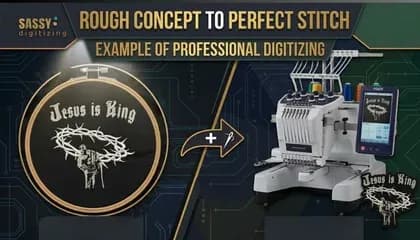
Embroidery Digitizing Case Study: Concept to Reality
June 9, 2026
13 min read
Sassy Digitizing
Expert insights, industry trends, and deep dives into the worlds of professional digitizing and embroidery production and vector art.

4.7/5
Guaranteed File Compatibility & Industry Standards





Upload your artwork and get a machine-ready embroidery file in just 2 to 4 hours. No upfront payment. Pay only after you approve. Free revisions included!
2–4 Hours
Rush Turnaround
100% Approval
Pay After Approval
Free Revisions
Until You're Happy
In the professional embroidery world, most clients provide a finished logo and simply ask for a stitch file. However, sometimes a client comes with something more challenging: a vision. They do not have a file. They have an idea, a feeling, and a message they want to see stitched onto fabric.
Recently, we worked on a project that proves why manual precision is superior to any automated digitizing approach. The goal was to create a powerful design featuring a fist, a Crown of Thorns, and bold Gothic typography. The journey from that initial idea to the final production sew-out required four distinct phases and true technical mastery at every step.
⚡ Case Study Overview
Project: Jesus is King, fist with Crown of Thorns, Gothic typography
Standard digitizing orders follow a predictable process: the client provides artwork, we build the stitch file, the client runs production. But conceptual projects are a different category entirely. They begin with an idea rather than a finished design, and they require the digitizing team to function as both technical specialists and creative partners simultaneously.
This project presented three layers of technical difficulty that most digitizing services decline to handle:
Technical challenge 1: Converting 3D photography to 2D stitch paths
The client supplied a high-definition photograph of a real Crown of Thorns as the design reference. A 3D photograph has depth, shadow, and complex surface detail that must be manually interpreted and simplified into clean, stitchable paths. There is no algorithm that performs this translation reliably. It requires a digitizer who understands both the visual result and the mechanical production constraints simultaneously.
Technical challenge 2: Sharp points without needle damage
Each thorn on the crown ends in a sharp point. Digitizing a sharp point requires the stitch sequence to taper correctly at the tip without creating a stitch density buildup that breaks needles or causes bird nesting on the bobbin. Every single thorn in this design required individual path planning to maintain its visual sharpness while remaining safe for production.
Technical challenge 3: Merging three complex elements into one cohesive design
The final design required three distinct elements (a textured fist, a tangled Crown of Thorns, and arched Gothic lettering) to merge visually and make the hand appear to be gripping the crown. Each element had different stitch requirements that had to coexist without overlapping density problems at the boundaries between them.
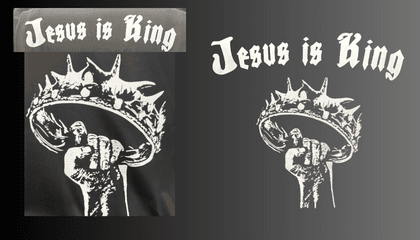
The project started when a customer approached Sassy Digitizing with a unique idea. Initially, the customer shared a high-contrast image of a fist holding a royal crown along with a bold Gothic font reading "Jesus is King." The combination of the powerful imagery and the spiritual message was compelling, but the customer quickly identified a mismatch.
A royal crown, with its polished symmetry and regal associations, did not fit the spiritual weight of the message. The customer wanted the design to be more meaningful and symbolic. They requested a major change: replace the royal crown with a Crown of Thorns. To ensure the detail was accurate and reverential, they provided a high-definition photograph of a real Crown of Thorns as the reference for the new element.
What this phase required: The ability to work with a concept revision mid-project and translate a photographic reference into a technically achievable design brief. Many digitizing services would have declined at this stage. We began planning how to turn a complex 3D photograph of natural, irregular organic material into clean, production-ready stitch paths.
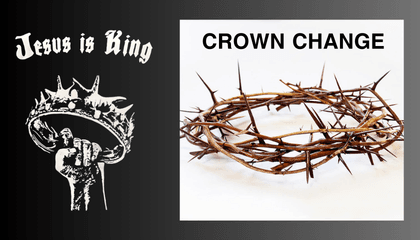
Replacing a standard geometric crown shape with a complex, tangled Crown of Thorns is a task that most embroidery companies cannot handle. The challenge is not artistic: it is purely technical. Transforming a 3D photograph into a 2D stitch file requires a digitizer who can mentally decompose the photographic detail into individual stitchable elements while simultaneously engineering each path for production.
Three specific production constraints had to be solved at this phase before any digitizing work began:
| Production Constraint | Technical Approach |
|---|---|
| Sharp thorn points without needle damage | Each thorn digitized as a separate tapered satin path; density reduced at tips to prevent needle strike buildup |
| Tangled, crossing thorn branches without bird nesting | Crossing paths sequenced to stitch in correct layer order; underlay adjusted to separate elements visually |
| 3D photographic depth converted to 2D flat stitch | Tonal variation from the photograph interpreted as stitch angle changes rather than color changes; created depth through direction not shade |
⚠️ Why this phase matters: This is exactly where auto-digitizing fails entirely. A pixel-tracing algorithm applied to a photograph of a Crown of Thorns would produce thousands of chaotic stitch paths following every shadow and surface texture in the image. The result would be unusable on any production machine. Manual planning before a single stitch is assigned is what makes complex photographic-reference work possible.
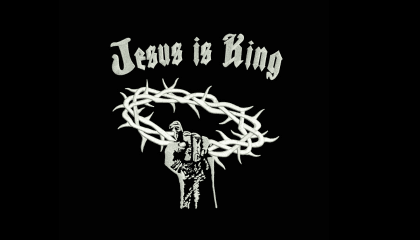
Our master digitizers spent many hours building this design manually. Every element was approached as a separate engineering problem before being integrated into the complete composition.
The Fist Element
We preserved the raw, gripping texture of the original fist artwork by using different stitch angles across the knuckle and finger areas. Rather than applying a single uniform fill angle, we varied the angles between sections to suggest the form of the hand at different planes. This created a realistic gripping effect that gave the fist visual weight and dimension on fabric.
The Crown of Thorns Element
Every thorn was digitized individually as a separate satin stitch path with its own taper, angle, and density settings. Each sharp point was engineered to remain clearly defined on the fabric without creating the stitch density buildup at the tip that causes needle damage. The crossing branch elements were sequenced in the correct layer order so that the visual tangling of the crown read correctly on the finished sew-out.
Merging the Fist and Crown
The most technically demanding step was merging the fist and Crown of Thorns into a single cohesive image where the hand appeared to be firmly grasping the crown. This required careful management of the boundary zone between the two elements so that stitch density from neither element bled into the other while still creating the visual impression of physical contact between them.
Gothic Typography Arch
The "Jesus is King" text was placed in a perfect arch over the composition using manually adjusted baseline settings. Gothic font letterforms have complex internal stroke variations: each character has thick and thin strokes that require different column widths and density values within the same piece of text. Every letter was individually refined to ensure the final text was clean and readable at production size.
💡 Technical insight: Gothic typography presents a unique digitizing challenge because the thick-to-thin stroke transitions in each letterform require the digitizer to switch compensation and density settings mid-character. A uniform density setting across a Gothic letter produces uneven coverage: the thick strokes look correct but the thin strokes collapse. Each character must be treated as a separate engineering problem within the single text element.
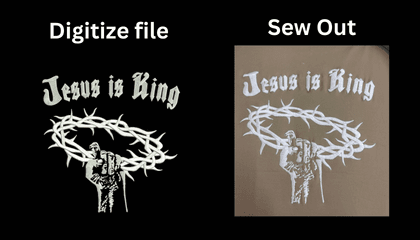
We delivered the file after our Quality Assurance team completed their review. The QA process checked stitch density across all elements, pull compensation values, thread path sequencing, and boundary zone management between the merged elements.
The true test came when the customer loaded the file on their machine. The final production result exceeded expectations:
✅ Customer outcome: The customer was thrilled. We had successfully translated their vision into a physical masterpiece that conveyed the spiritual weight of the message through technically precise embroidery on fabric. A concept photograph became a production-ready file and then a wearable work of craft.
Every complex project teaches specific technical principles. This case study illustrated several that apply directly to any embroidery digitizing project involving detailed or conceptual artwork:
| Technical Principle | Application in This Project |
|---|---|
| Separate paths for sharp details | Each thorn digitized individually rather than as part of a group; preserved definition at every tip |
| Stitch angle as depth simulation | Varying fill angles across the fist created the visual impression of 3D form in flat thread |
| Layer sequence management | Crossing thorn branches sequenced in correct order so visual layering read correctly on fabric |
| Density management at merge zones | Boundary between fist and crown carefully managed to prevent double-density at the join |
| Variable column width for complex typography | Gothic letterforms required different settings on thick and thin strokes within each character |
| QA before delivery on complex files | Secondary review checked every element boundary, all thorn tips, and typography density before the file was sent |
This case study demonstrates that Sassy Digitizing is more than a file conversion service. We are a top-10 embroidery digitizing company that understands the craft at every level. We do not just trace images. We build designs for production.
Creative Flexibility
We work with your ideas, concepts, and photographic references to create exactly what you envision. Mid-project design shifts, reference photographs, and complex symbolic elements are not problems for our team. They are the kind of work we do best.
Industrial Efficiency
Every file we build is optimized for high-speed production runs with no thread breaks. Complex designs do not have to mean slow machines or frequent operator interventions. Our thread path optimization and density engineering ensure that even the most intricate designs run cleanly from start to finish.
Free Trial on Your First Logo
We offer a free trial for your first logo under 5 inches. This means you can experience our manual precision on your own production machines before committing to a paid order. If it does not sew cleanly, we revise it for free until it does.
Do not settle for average quality when you can have a masterpiece. Whether your project is a standard left chest logo or a complex conceptual design built from a photograph, the level of care and technical precision is the same at Sassy Digitizing.
If you have a complex design that other services have declined, a vision you cannot fully articulate as artwork yet, or a production problem with an existing file, bring it to us. We love technical challenges. From the first concept photograph to the final perfect sew-out, we are your partners in excellence.
What this project demonstrates about manual digitizing:
| ✅ | Photographic references can be converted to production-ready stitch files with manual digitizing expertise |
| ✅ | Sharp decorative points can be stitched cleanly without needle damage when each is individually path-planned |
| ✅ | Multiple complex elements can be merged into a single cohesive design with no density buildup at boundaries |
| ✅ | Complex conceptual projects can be delivered within the standard 2 to 4 hour window with full QA |
| ✅ | Manual precision produces zero thread breaks and a clean sew-out on the first production run |
Bring it to Sassy Digitizing. We specialize in the difficult projects: photographic references, intricate detail work, conceptual designs, and any project that requires manual precision at the highest level.
First logo under 5 inches digitized free. Test it on your own machines before you commit.
Senior Quality Control (HOD)
As the Head of Quality Control at Sassy Digitizing, Keith brings over 12 years of hands-on commercial embroidery experience to the table. He is our resident problem-solver, specializing in the technical nuances of stitch density, pull compensation, and complex digitizing. When he's not establishing quality standards for 3D puff and appliqué, you'll find him perfecting the art of small lettering to ensure every stitch counts.
Expertise:
Lightning-Fast Delivery
Get your file in 2–4 hours, every time.
Expert Quality
38+ expert digitizers with years of experience.
24/7 Support
We're here to help, anytime you need us.
Secure & Confidential
Your files are safe with us. Always.
Upload your artwork now and let our experts turn it into perfection, fast.
1,794+
Happy Clients
4.7★
Client Rating
38+
Expert Digitizers
6+
Years Experience
© 2026 Sassy Digitizing LLC. All Rights Reserved.

Scale your apparel brand or embroidery shop with the best embroidery digitizing service of 2026. Sassy Digitizing comple…
Stop ruining structured hats with flat sew files. Discover the essential digitizing secrets for curved 3D surfaces inclu…

High embroidery stitch density is the most common reason designs come out stiff, raised and bulky. This guide covers the…